
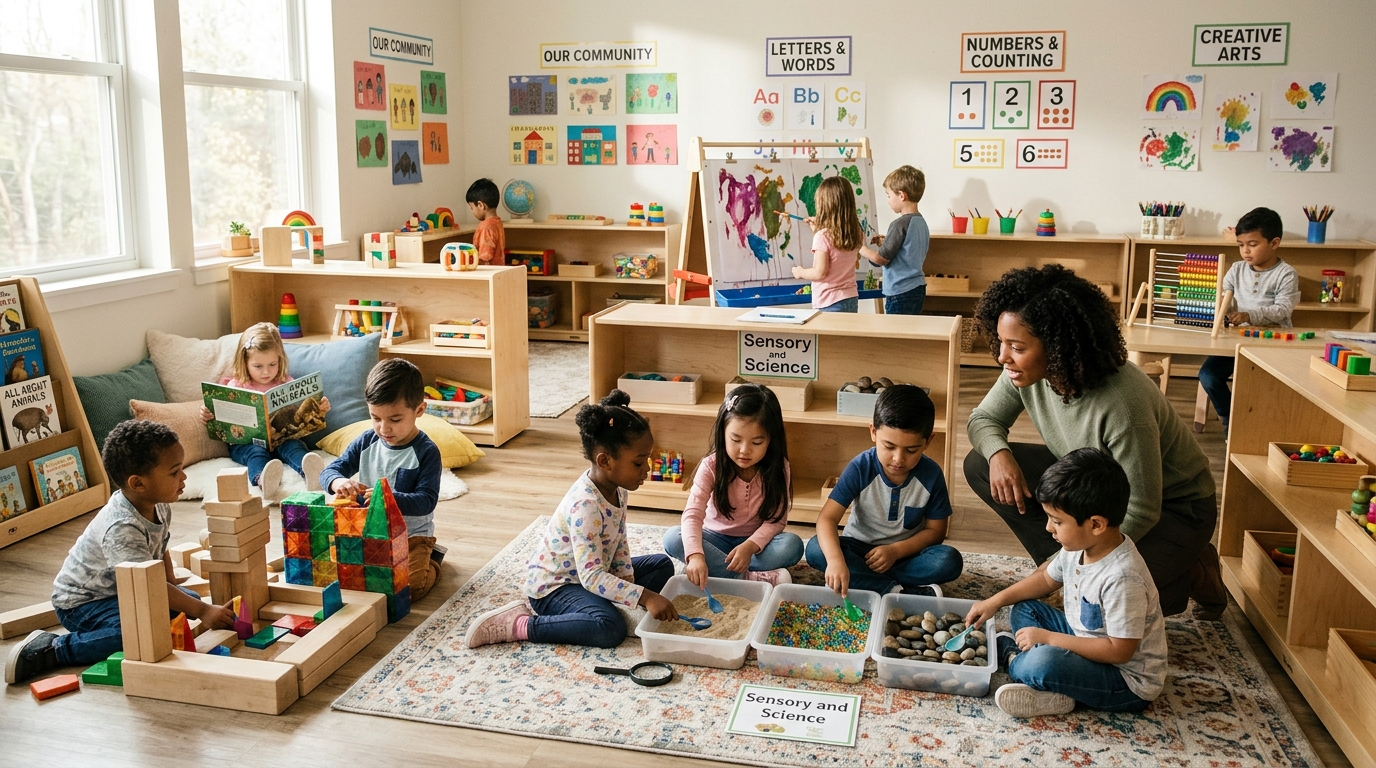

The early years of childhood play a major role in shaping how children communicate, solve problems, build relationships, and engage with learning. During this stage, children learn best when they are encouraged to explore, experiment, and participate actively in meaningful experiences rather than simply being instructed what to do.
Play-based learning environments support this process by creating opportunities for children to investigate ideas, express creativity, and build confidence through everyday interactions. These experiences help children develop important social, emotional, and cognitive skills that continue to support learning throughout life.
Table of Contents
The Importance of Responsive Educators
Educators play a central role in shaping positive early learning experiences. Children thrive when adults respond thoughtfully to their interests, ideas, and emotions while encouraging conversation, exploration, and collaboration.
Supportive educator-child relationships help children feel safe enough to take risks in their learning, whether that involves asking questions, trying new activities, or solving problems independently. Through consistent and responsive interactions, children begin to develop confidence in their own abilities and communication skills.
Strong relationships in early learning environments are also closely connected to emotional wellbeing, helping children feel a sense of belonging and security within their daily routines.
Learning Through Environment and Exploration
The physical environment can significantly influence how children engage with learning. Spaces that encourage creativity, movement, and open-ended play often inspire children to explore more freely and interact more confidently with others.
Flexible learning environments allow children to adapt spaces to their own ideas and interests. Whether rearranging materials, engaging in imaginative roleplay, or creating collaborative projects, children learn through experimentation and active participation.
Thoughtfully designed learning environments can encourage creativity, communication, and curiosity by giving children opportunities to explore ideas through play and everyday experiences. This is reflected in approaches to playful enquiry-based learning.
Encouraging Literacy Through Play
Language and literacy development are often most effective when introduced naturally through play and interaction. Storytelling, music, movement, rhymes, and dramatic play all help children build communication skills while making learning enjoyable and engaging.
Rather than focusing only on formal instruction, many early childhood settings integrate literacy into everyday activities. This approach helps children develop familiarity with language in ways that feel meaningful and accessible.
Playful literacy experiences also encourage children to build confidence with self-expression and social interaction while supporting listening and comprehension skills during the early years.
Research around early literacy development in young children highlights the importance of interactive, language-rich experiences in helping children develop strong communication foundations before formal schooling begins.
Real-World and STEAM Learning Experiences
Hands-on learning experiences help children connect ideas with the world around them. Nature play, community exploration, sensory experiences, and practical problem-solving activities all encourage children to observe, question, and experiment.
Many early learning environments now incorporate STEAM learning, which includes science, technology, engineering, arts, and mathematics, into everyday play experiences. Introducing these concepts during the early years supports creativity, curiosity, and critical thinking in age-appropriate ways.
These experiences are not about formal academic pressure but rather about encouraging children to explore how things work, test ideas, and develop confidence through discovery and experimentation.
Technology as a Creative Tool
Digital technology is becoming increasingly common in early childhood settings, but its role is most valuable when used as a creative and interactive tool rather than passive entertainment.
When children use technology to create stories, solve problems, explore ideas, or collaborate with others, it can support communication and creative thinking skills alongside traditional play experiences.
Discussions around creative technology use for children highlight the importance of balancing digital experiences with creativity, interaction, and hands-on learning.
Supporting Lifelong Learning
Ultimately, early childhood learning is about more than preparing children academically. Experiences built around curiosity, creativity, exploration, and supportive relationships help children develop confidence, resilience, and a genuine enjoyment of learning.
When children are encouraged to ask questions, explore ideas, and participate actively in their environment, they begin building skills that support not only school readiness but also lifelong learning and personal growth.